
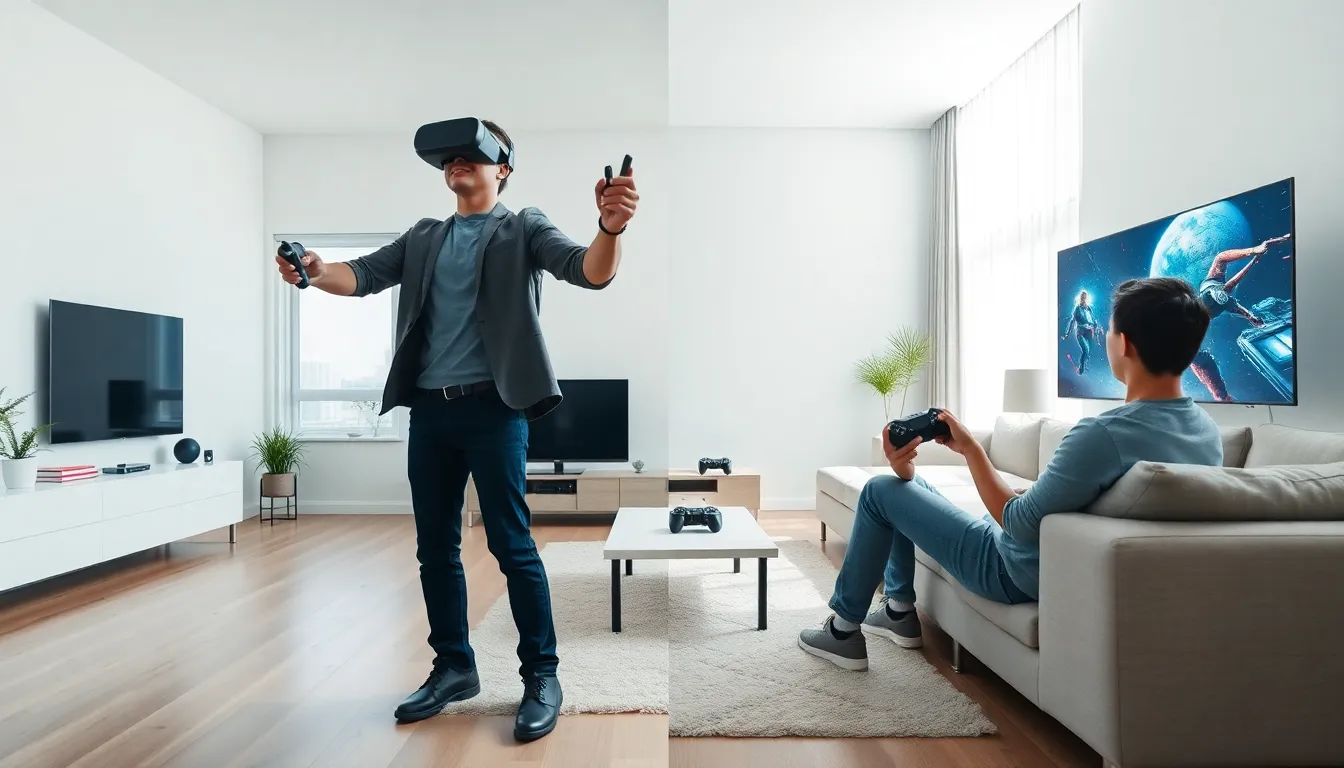
VR gaming vs traditional gaming is a debate that continues to grow as technology advances. Both offer distinct experiences, and choosing between them depends on personal preferences, budget, and gaming goals. Virtual reality immerses players in 3D environments, while traditional gaming delivers entertainment through screens and controllers. This article breaks down the key differences between VR gaming and traditional gaming. It covers immersion, cost, health factors, and game availability. By the end, readers will have the information they need to decide which gaming style fits their lifestyle.
Table of Contents
ToggleKey Takeaways
- VR gaming vs traditional gaming comes down to immersion versus accessibility—VR places you inside the game world, while traditional gaming offers comfort and convenience.
- Traditional gaming costs less overall, with consoles starting at $300, while full VR setups can exceed $3,000 for premium experiences.
- VR gaming provides physical benefits like calorie-burning workouts through games like Beat Saber, but may cause motion sickness for some users.
- Traditional platforms offer thousands of titles across decades, while VR libraries are smaller but growing with standout games like Half-Life: Alyx.
- VR requires dedicated physical space and setup time, whereas traditional gaming works immediately with any TV or monitor.
- Your ideal choice in the VR gaming vs traditional gaming debate depends on your budget, available space, and whether you prioritize deep immersion or game variety.
Understanding the Core Differences
VR gaming vs traditional gaming starts with how players interact with the game world. Traditional gaming uses a screen, controller, and sometimes a keyboard and mouse. Players view the action from an external perspective. VR gaming places the player inside the game. A headset displays a 360-degree environment, and motion controllers track hand movements.
Traditional gaming has existed for decades. Consoles like PlayStation, Xbox, and Nintendo Switch dominate the market. PC gaming also holds a strong position. These platforms use proven technology that most players already understand.
VR gaming requires specialized hardware. Headsets like the Meta Quest 3, PlayStation VR2, and Valve Index create immersive experiences. Some systems need a powerful PC to run, while others work as standalone devices. The technology is newer and continues to improve each year.
The control schemes differ significantly. Traditional games rely on button inputs and analog sticks. VR games track physical movements. Swinging a sword in VR means actually swinging your arm. This fundamental difference shapes every aspect of gameplay.
Immersion and Gameplay Experience
Immersion separates VR gaming vs traditional gaming more than any other factor. Traditional games display action on a flat screen. Players watch characters perform actions. The experience feels engaging but maintains a clear separation between player and game world.
VR gaming eliminates that barrier. Players look around by turning their heads. They reach out to grab objects. Horror games become genuinely frightening when enemies approach from all directions. Racing games feel more intense when players sit inside a virtual cockpit.
The sense of presence in VR changes how players respond emotionally. Looking down from a virtual cliff triggers real vertigo for many users. Social VR games allow face-to-face conversations with avatars that mimic real expressions. This level of engagement simply doesn’t exist in traditional formats.
Traditional gaming offers its own strengths. Players can game for hours without physical strain. Complex strategy games with detailed interfaces work better on monitors. Competitive esports titles like League of Legends and Counter-Strike 2 remain on traditional platforms for practical reasons.
Gameplay depth varies across both formats. Some argue traditional games offer more complex mechanics. Others point to VR titles like Half-Life: Alyx as proof that virtual reality can deliver sophisticated experiences. The best choice depends on what type of experience a player wants.
Cost and Accessibility Comparison
Cost plays a major role in the VR gaming vs traditional gaming decision. Traditional gaming hardware ranges from affordable to premium. A Nintendo Switch costs around $300. A high-end gaming PC can exceed $2,000. Most players find options within their budget.
VR gaming requires additional investment. Entry-level headsets like the Meta Quest 3 start at $500. Premium PC VR setups demand both an expensive headset and a capable computer. The total cost can reach $3,000 or more for top-tier experiences.
Game prices remain similar across both platforms. New releases typically cost $60-70. VR games sometimes offer shorter experiences at lower price points. Traditional gaming provides more sales and subscription services like Xbox Game Pass.
Accessibility extends beyond money. Traditional gaming works in any living room with a TV. VR gaming needs physical space. Room-scale VR experiences require a clear play area of at least 6.5 feet by 6.5 feet. Smaller spaces limit gameplay options.
Setup complexity differs too. Traditional consoles plug into a TV and work immediately. VR systems require calibration, boundary setup, and sometimes external sensors. The technical barrier remains higher for virtual reality.
Health and Physical Considerations
Health factors deserve attention in any VR gaming vs traditional gaming comparison. Traditional gaming presents familiar concerns. Extended sessions can cause eye strain, poor posture, and repetitive motion injuries. Most players manage these risks with breaks and ergonomic setups.
VR gaming introduces new considerations. Motion sickness affects many users, especially beginners. The disconnect between visual movement and physical stillness triggers nausea for some players. This improves with exposure, but it never disappears for everyone.
Physical activity sets VR apart. Games like Beat Saber and Supernatural provide genuine workouts. Players burn calories while gaming. This appeals to those who want entertainment and exercise combined. Traditional gaming rarely offers this benefit.
Eye health concerns exist for both formats. VR headsets place screens inches from the eyes. Long-term effects remain under study. Traditional gaming at proper distances with good lighting poses fewer direct eye health questions.
Social health differs between platforms. Traditional gaming supports couch co-op and local multiplayer. Friends share the same physical space. VR isolates the headset wearer from their surroundings. Social VR exists, but it replaces rather than complements in-person interaction.
Game Library and Content Availability
Game selection matters greatly in VR gaming vs traditional gaming debates. Traditional platforms offer thousands of titles across every genre. Decades of development have created massive libraries. Players find everything from indie experiments to blockbuster franchises.
VR gaming has a smaller but growing catalog. Popular titles include Beat Saber, Half-Life: Alyx, Resident Evil 4 VR, and Asgard’s Wrath 2. The library expands each month. But, it can’t yet match the variety of traditional gaming.
Genre availability differs between platforms. Traditional gaming excels at real-time strategy, complex RPGs, and competitive multiplayer. VR gaming shines in first-person experiences, rhythm games, and simulation titles. Some genres work better in one format than the other.
Major publishers increasingly support VR. Capcom, Ubisoft, and Rockstar have released VR versions of popular games. This trend suggests growing industry confidence in the platform. Still, most major releases target traditional platforms first.
Backward compatibility gives traditional gaming an edge. Players access games from previous generations. VR lacks this history. The oldest VR games date back less than a decade. Traditional gamers enjoy libraries built over 40+ years.