
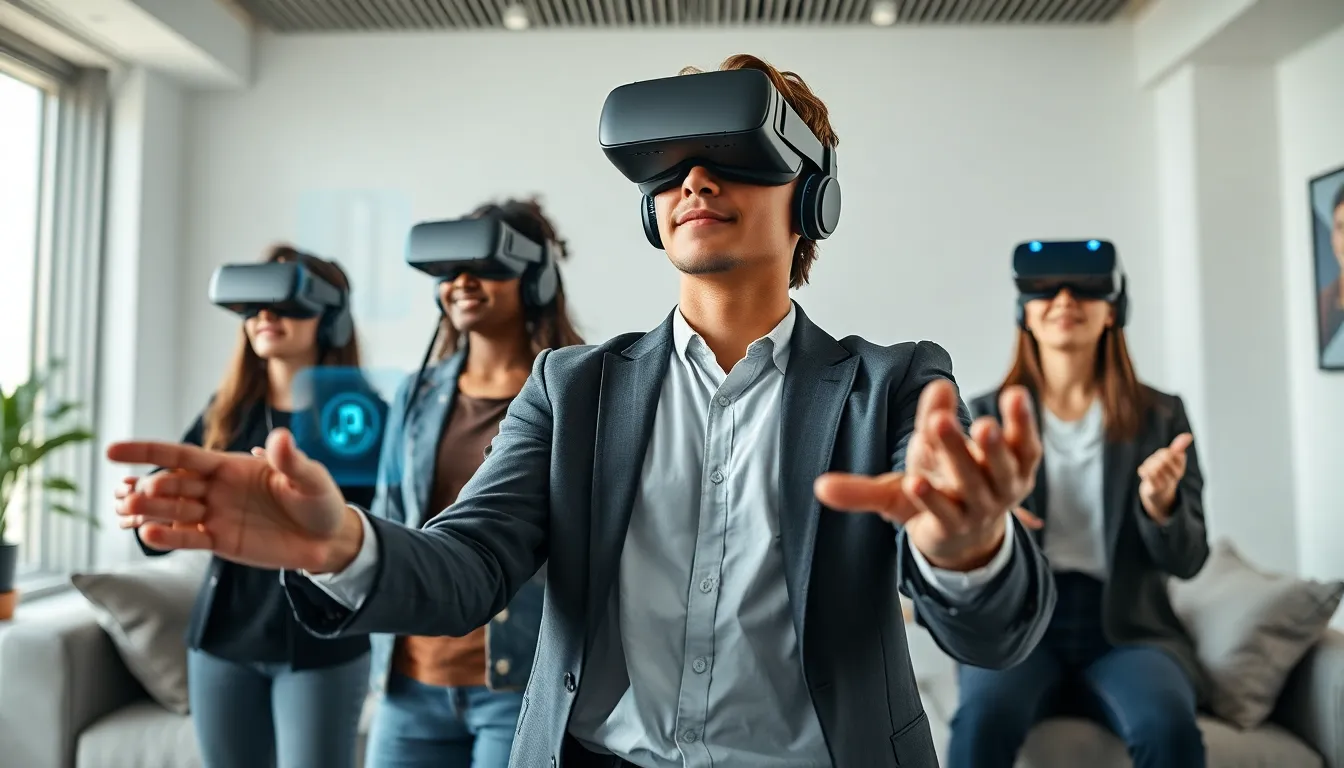
VR gaming trends 2026 point toward a significant shift in how players experience virtual worlds. The technology has matured. Prices have dropped. And developers are building experiences that feel more real than ever before.
This year marks a turning point for VR gaming. Major hardware manufacturers are releasing lighter, more powerful headsets. AI integration is changing how games respond to player behavior. Social features are transforming solo experiences into shared adventures.
The VR gaming trends 2026 landscape looks different from just two years ago. Haptic technology now lets players feel textures and impacts. Mixed reality blends physical and digital spaces in ways that seemed impossible a decade ago. These advances signal that VR gaming has moved past its experimental phase into mainstream adoption.
Table of Contents
ToggleKey Takeaways
- VR gaming trends 2026 show mainstream adoption with headsets now under $300, 30-40% lighter, and featuring lag-free wireless connectivity.
- AI-powered NPCs remember interactions and form opinions, creating personalized gaming experiences that adapt to player behavior.
- Social VR has become dominant, with massive multiplayer worlds supporting thousands of players and cross-platform compatibility across all headsets.
- Haptic gloves and full-body feedback suits at consumer prices let players feel textures, impacts, and environmental effects like never before.
- Mixed reality blurs physical and virtual spaces, with games that adapt to your room and transform real-world locations into interactive playgrounds.
- These VR gaming trends 2026 signal the technology has matured from experimental to practical everyday entertainment.
More Affordable and Accessible Headsets
Price has long been VR gaming’s biggest barrier. That’s changing fast in 2026.
Entry-level VR headsets now cost under $300 without sacrificing quality. Companies like Meta, Sony, and emerging Chinese manufacturers have driven production costs down through improved supply chains and component standardization. The VR gaming trends 2026 show a clear pattern: better hardware at lower prices.
Weight reduction is another major development. New headsets weigh 30-40% less than models from 2023. This makes extended play sessions comfortable rather than exhausting. Players can wear devices for hours without neck strain or headaches.
Setup complexity has also decreased. Most 2026 headsets work right out of the box. No external sensors. No base stations. No complicated calibration. Users put on the headset and start playing within minutes.
Wireless connectivity has become standard across price points. Even budget headsets now offer lag-free wireless play. This removes the tripping hazard of cables and gives players full freedom of movement.
Battery life has improved substantially too. Many 2026 models offer 3-4 hours of continuous gameplay. Some include hot-swappable batteries for unlimited sessions. These VR gaming trends 2026 make the technology practical for everyday use.
AI-Powered Immersive Experiences
Artificial intelligence is reshaping VR gaming in 2026. Games now adapt to how players behave, creating personalized experiences.
NPC behavior has reached new levels of sophistication. Non-player characters remember previous interactions. They form opinions about players. They react emotionally to player choices. This creates the feeling of interacting with actual personalities rather than scripted responses.
Procedural content generation powered by AI means environments change each session. Dungeons reconfigure themselves. Cities evolve based on player actions. Stories branch in unexpected directions. The VR gaming trends 2026 show that static, repeatable experiences are becoming outdated.
Voice recognition allows natural conversation with in-game characters. Players speak normally and receive contextually appropriate responses. Language models trained specifically for gaming contexts understand commands, questions, and even jokes.
AI also assists with accessibility. Games automatically adjust difficulty based on player skill. Visual and audio cues adapt for players with disabilities. VR gaming trends 2026 emphasize inclusion through intelligent design.
Graphic rendering benefits from AI upscaling techniques. Headsets display sharper images while reducing processing demands. This means better visuals without requiring expensive gaming PCs.
Social and Multiplayer VR Gaming Growth
VR gaming in 2026 has become fundamentally social. Solo experiences still exist, but shared virtual spaces now dominate player attention.
Massive multiplayer VR worlds support thousands of simultaneous players. These aren’t simple chat rooms with avatars. They’re fully realized game environments where players quest, build, and compete together in real time.
Avatar technology has advanced dramatically. Players create detailed representations of themselves or entirely fictional personas. Facial tracking captures expressions. Body tracking replicates physical movements. Conversations feel face-to-face even across continents.
Spectator modes let friends watch gameplay from within the virtual world. They can cheer, comment, and interact without affecting the main player’s experience. This creates shared entertainment experiences similar to watching sports together.
Cross-platform play has become standard for VR gaming trends 2026. Players on different headset brands join the same servers. Hardware choice no longer fragments communities. Everyone plays together regardless of their device.
In-game voice chat has improved with spatial audio. Players hear others based on virtual position. Someone standing to the left sounds like they’re actually to the left. This subtle detail makes social interaction feel natural and intuitive.
Haptic Feedback and Sensory Advancements
Touch is VR gaming’s new frontier in 2026. Haptic technology has evolved beyond simple controller vibrations.
Haptic gloves have reached consumer pricing. Players feel textures when touching virtual surfaces. They sense resistance when gripping objects. Fingers register the difference between rough stone and smooth glass. These VR gaming trends 2026 add a dimension that screens never could.
Vest and suit systems provide full-body feedback. Players feel impacts during combat. They sense environmental effects like wind and rain. Some systems even simulate temperature changes, warming or cooling skin based on virtual conditions.
Controller-free hand tracking has improved to near-perfect accuracy. Cameras on headsets capture finger movements precisely. Players grab, throw, and manipulate objects using natural hand gestures. The technology removes the barrier between intention and action.
Audio immersion has also advanced. Spatial audio systems create convincing 3D soundscapes. Players locate sounds directionally with accuracy. Footsteps behind actually seem behind. The VR gaming trends 2026 treat sound as equally important to visuals.
Smell remains experimental but shows promise. Several companies have introduced scent devices that pair with specific games. The technology is basic, perhaps a dozen distinct scents, but it hints at fully immersive sensory experiences ahead.
Mixed Reality and Hybrid Gaming Experiences
The boundary between VR and the physical world is blurring in 2026. Mixed reality represents one of the most significant VR gaming trends 2026 has delivered.
Passthrough technology lets players see their real environment overlaid with virtual elements. Monsters appear in living rooms. Puzzle pieces sit on actual tables. Games use real furniture as obstacles and surfaces.
Room-scale experiences adapt to available space. Algorithms scan physical environments and adjust game worlds accordingly. A small apartment becomes a cramped spaceship corridor. A large basement transforms into an open arena. Games fit the player’s space rather than demanding specific setups.
Hybrid gaming combines physical activity with virtual challenges. Players run, jump, and dodge real obstacles while engaging virtual threats. Fitness applications disguise workouts as adventures. The VR gaming trends 2026 blur the line between exercise and entertainment.
Outdoor mixed reality is emerging as a category. GPS-enabled experiences transform parks and neighborhoods into game worlds. Players explore actual locations while encountering virtual characters and challenges. This extends VR gaming beyond indoor spaces.
Collaboration between VR and AR devices allows shared experiences across device types. Someone wearing a full VR headset plays alongside someone using AR glasses. Both participate in the same game from different perspectives. This flexibility makes group gaming more accessible.